
FREQUENTLY ASKED QUESTIONS
-
AFFA is a dedicated fencing club based in Garwood, NJ and Hamilton, NJ (referred to as the Princeton location due to our start at Princeton University) focused exclusively on saber fencing. Our program is built and led by coaching staff with Olympic and NCAA Division I experience, giving fencers at every level - from first-time beginners to nationally ranked competitors - direct access to elite-level instruction.
-
Fencing combines physical and mental development. It builds explosive speed, agility, footwork, reflexes, cardiovascular fitness, balance, and full-body strength while sharpening strategic thinking, split-second decision-making, discipline, and focus. Often described as "physical chess," fencing also teaches accountability, resilience, and composure because it is an individual sport. Fencing can also be meaningful in the college admissions and recruiting process: it is an NCAA varsity sport at many top universities, including Ivy League and other highly selective schools, and dedicated fencers may stand out to college coaches and admissions offices because roster spots and the applicant pool are smaller than in many mainstream sports.
-
Saber is a distinct weapon with its own footwork, timing, target area, and right-of-way rules. Specializing in one weapon lets AFFA build its coaching system, class curriculum, and competitive pipeline entirely around saber's specific skills rather than splitting attention across three weapons. This is the same model used by many top saber-specific clubs and college programs.
-
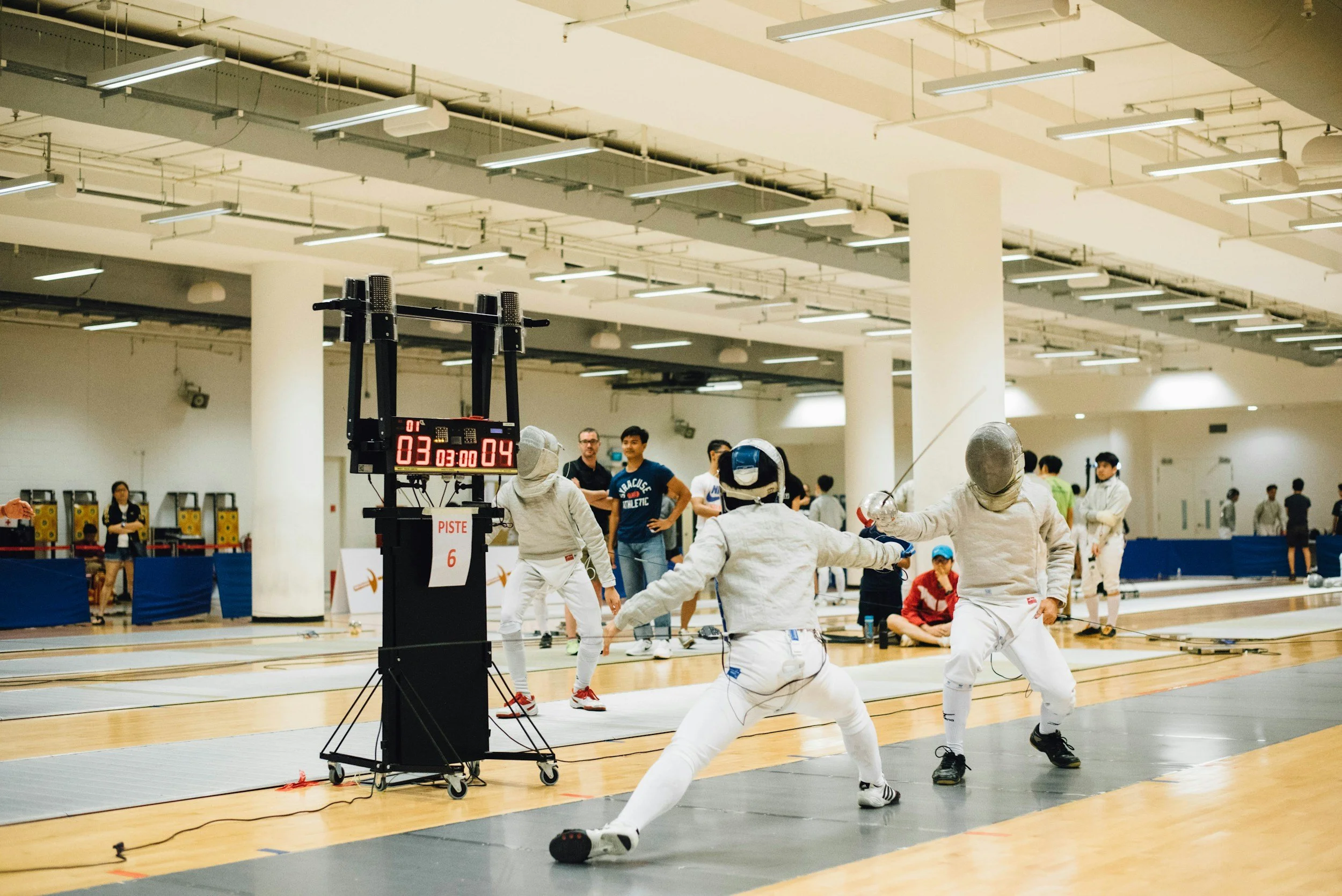
Saber is a fast-paced, right-of-way weapon where touches can be scored with the edge or point of the blade anywhere from the bend of the hips up, including the torso, arms, head, and mask. It rewards explosive footwork and quick tactical decisions. Foil and epee fencers typically score only with the tip of the blade. Saber is usually the fastest and most visually exciting of the three Olympic fencing weapons.
-
AFFA welcomes students starting at age six, with programming for youth beginners, teens, and adults. No prior experience is necessary. Beginner classes assume zero background and start with the fundamentals of footwork, blade control, safety, and saber rules. Age and experience determine the best class group.
-
Yes. Fencers wear FIE- or USA Fencing-rated protective equipment, including a mask, jacket, glove, underarm protector, and for saber, a conductive lame and mask overlay. Touches are governed by strict rules of engagement. Independent injury studies consistently rank fencing among the safer competitive sports, including for youth athletes, because it is non-contact and heavily regulated.
About AFFA & Why Saber-Only
-
Yes. Anyone trying fencing for the first time, or simply checking out AFFA before joining, is welcome to a free trial lesson. This is a one-time, 20-minute one-on-one session with one of our experienced coaches, with no cost or commitment. All equipment is provided. Bring comfortable athletic clothing, sneakers, and a willingness to try something new.
-
No. New and trial fencers can use club-provided loaner equipment, including a mask, jacket, glove, and saber, for their first classes. Once a fencer decides to continue, rentals are available or families can transition to personally fitted gear for purchase.
-
Athletic clothing they can move freely in, such as leggings or joggers and a T-shirt, plus sneakers with good lateral support. Tie back long hair and avoid loose jewelry. AFFA provides protective equipment for trial and beginner classes.
-
Create an account with AFFA, then choose the option that fits best: a membership/package for ongoing training or an individual class pass to attend one class at a time. Registration can be completed online, by email, or by calling AFFA directly.
862-445-7078
Getting Started & Trial Classes
Group Classes
-
AFFA offers a clear class pathway so every fencer trains at the right level:
Intro - A 1-month program for brand-new fencers covering basic footwork, blade fundamentals, and safety rules before joining an ongoing class.
Beginner - Builds on Intro with more structured technique, drilling, and an introduction to bouting.
Intermediate - For fencers with solid fundamentals, adding tactical concepts, more advanced bladework, and increased bouting.
Advanced - The most competitive track, focused on high-level technique, strategy, and tournament preparation.
Adult - A dedicated class for adult fencers of all experience levels, from complete beginners to those returning to the sport.
-
Placement is determined by the coaching staff based on evaluation, age, and experience. Coaches assess each student individually and place them where they'll be challenged appropriately and progress fastest, with flexibility to move between levels as they develop.
-
For recreational fencers, one to two classes per week is a common starting point. Fencers aiming to compete regularly typically train more and often add private lessons.
-
Classes generally include a dynamic warm-up, footwork drills, bladework and technique instruction, partnered drilling, and supervised bouting (sparring) at the end.
-
Yes. Coaches regularly reassess progress based on skill development, footwork and bladework consistency, tactical understanding, and performance in bouting. Fencers can move levels whenever it is the right fit. Private lessons can accelerate progress through focused one-on-one correction.
-
Because AFFA offers numerous classes throughout the week across two locations, formal makeup scheduling is not required. If a fencer misses a class, they may attend a different class day or time that fits their schedule. Across both locations, class availability is offered six days a week.
private lessons
-
A private lesson is one-on-one instruction between a fencer and a coach using target mitts and individualized footwork and bladework drilling. It is the fastest way to correct technique, build an individual tactical toolkit, and prepare for specific opponents or upcoming events in greater depth than a group setting allows.
-
Right away. Private lessons accelerate learning from day one through focused technical correction. Private lessons are built into AFFA's Intro package as well as the Bronze and Silver tiers so fencers can develop sound fundamentals early.
-
Private lessons are 20-minute one-on-one sessions. Double lessons are available as 40-minute sessions. Private lesson purchases never expire.
Members: 1 lesson - $70
Members: 5-lesson pack - $325
Members: 10-lesson pack - $600
Non-members: 1 lesson - $85
-
Private lessons can be purchased online or by calling AFFA directly.
-
Private lessons must be cancelled or rescheduled at least 24 hours in advance. Cancellations made with less than 24 hours notice will be charged in full because that time is reserved specifically for the fencer and coach.
EQUIPMENT & GEAR
-
A full saber kit typically includes a mask with conductive bib, fencing jacket, underarm protector (plastron), saber-specific conductive lame, glove, knickers/breeches, socks, chest protector (required for anyone under 18 and for women), electric saber, and body wire. Beginners can use club loaner gear before purchasing their own.
-
Most clubs recommend investing in personal gear once a fencer commits beyond the trial period for fit, hygiene, and reliability. Personal gear is also required to enter USA Fencing-sanctioned tournaments.
-
Equipment is available for purchase directly from the club or from any vendor of your choice.
-
A complete beginner saber kit generally runs $400-$650 depending on brand and whether it is electric-ready. Costs vary by retailer and can often be phased in, such as mask and jacket first, then electric weapon and lame later.
-
Masks, lames, and body cords should be checked regularly for conductivity and mesh integrity. Most tournaments require masks to pass a punch test and equipment to pass an electric check. Growing fencers will also need larger jackets and gloves over time. AFFA is happy to check gear at the club.
-
Yes. AFFA offers equipment repairs at the club whenever possible.
AFFA Membership, Tuition, Billing & Club Policies
-
The Free Trial Lesson and Introductory Package are available without an AFFA membership. For ongoing class packages, private lessons at member rates, member benefits, and strip coaching access, an active AFFA membership applies. AFFA membership is separate from USA Fencing membership.
MEMBERSHIP OPTIONS
1 Person
Monthly: $120
Yearly (Auto-Renew): $800
Yearly: $900
2nd Family Member
Monthly: $120
Yearly (Auto-Renew): $650
Yearly: $750
3rd Family Member
Monthly: $120
Yearly (Auto-Renew): $400
Yearly: $600
-
All ongoing monthly class packages require an active AFFA membership:
Bronze Package - $499/month: 1 class per week + 1 private lesson per week
Silver Package - $699/month: 2 classes per week + 1 private lesson per week
Gold Package - $600/month: 3 classes per week
Platinum Package - $720/month: Unlimited classes per week
-
Membership includes unlimited facility use, free open bouting, access to tournament strip coaching, discounted pricing, priority booking, and college recruiting assistance. Choosing auto-renewal on a yearly membership saves money compared with the standard yearly rate, and additional family members receive discounted yearly rates.
-
Class packages are billed monthly and can be paid via autopay, check, credit card (processing fee applies), cash, or Zelle. Zelle payments should be sent to the fencer's specific home club location. Private lesson packages never expire and are purchased as needed. Yearly memberships are billed annually and can be paid via auto-renewal, check, credit card, cash, or Zelle.
-
AFFA does not charge a registration fee. The Free Trial Lesson and Introductory Package are available without membership. Without membership, services are billed a la carte and do not include member discounts or ongoing Bronze/Silver/Gold/Platinum package access. Yearly membership rates include discounts for auto-renewal and additional family members.
-
For yearly memberships, no refund is available except when the error was AFFA's. A freeze can be requested on repurchase and requires at least 15 days written notice by email or through the Mindbody portal for lesson reservations. If AFFA terminates a yearly membership for any reason, the remaining time will be prorated and refunded, with a $15 refund fee.
-
AFFA does not currently offer its own scholarships or financial aid. USA Fencing resources include the GRACE Program, which provides competition fee waivers for members facing sudden financial hardship who want to compete at national events, and Fencing the Gap, which offers scholarships, grants, and incentives intended to reduce financial, geographic, and cultural barriers. Families needing assistance should speak with their coach.
-
Yes. All AFFA families sign a general liability waiver covering Code of Conduct expectations for athletes, parents, and coaches as part of enrollment. This is separate from USA Fencing membership.
Strip Coaching (Tournament & Bout Coaching)
-
Strip coaching is when a coach works directly with a fencer during competition - between bouts, during the 1-minute breaks in Direct Elimination bouts, and between periods - offering real-time tactical adjustments, scouting the opponent, and helping manage the fencer's mindset under pressure. It is separate from regular lesson and class instruction and is typically booked for specific tournaments.
-
Strip coaching is billed as a separate fee and is not included in tuition or membership pricing. Current AFFA membership is required to access strip coaching from AFFA staff at competitions.
-
Contact the office to request a coach or sign up directly using the tournament coaching link. Tournaments where AFFA coaching staff will be attending are listed there. For national or international World Cup events, speak directly with your coach or the front desk to make arrangements.
-
Yes. AFFA coaches attend all national events and maintain a list of other out-of-state tournaments where staff will be present. World Cup events are by request only, so families should arrange coaching in advance.
-
Fees vary by tournament level:
Local - Tournaments within 50 miles of AFFA, in NJ only: $50 per fencer for the first event of the day, plus $15 per additional event the same day.
Regional - Events that award regional points and are required for qualification to Summer Nationals (RYC, RJCC, ROC): $100 per fencer per event, plus a $50 travel fee if the event is outside NJ.
National - Events that provide exposure to the highest level of competition and award national points and ranking (SYC, SJCC, NAC): $180 per fencer per event.
-
Yes. AFFA coaches regularly coach multiple students at the same tournament to help keep expenses lower for families. When needed, AFFA sends multiple coaches to provide appropriate coverage and attention.
-
Parents are welcome to support from the spectator area, but under USA Fencing rules only accredited coaches may stand at the strip during a bout to coach. AFFA can send fencers in with a simple game plan for events without a coach on-site.
USA Fencing Membership, SafeSport & Insurance
-
A USA Fencing membership is required once a fencer moves beyond the trial/intro package because it provides insurance coverage for club activities. USA Fencing membership is also required to enter sanctioned tournaments.
-
For recreational or class-only fencers, an Access Membership is typically sufficient. Fencers entering USA Fencing-sanctioned local, regional, or national tournaments need a Competitive Membership. Parents who want to vote in USA Fencing elections or volunteer in an official capacity can take out a free Parent Membership. Current membership types and pricing are listed through USA Fencing Membership & Fees.
-
Parents create their own account first, add a dependent (junior) profile for their child, and purchase the appropriate membership on that profile. Register or manage memberships at member.usafencing.org.
-
SafeSport is the U.S. Center for SafeSport's abuse-prevention training and reporting framework, adopted by U.S. Olympic National Governing Bodies including USA Fencing. Coaches, referees, and other adults with regular contact with minor athletes are required to complete a background screen and annual SafeSport training. Minor athletes are not required to complete SafeSport training. Requirements are detailed in USA Fencing FenceSafe Policies.
-
A coach's current background-screen and SafeSport-training status can be checked through USA Fencing's public safety search. All AFFA coaches are SafeSport compliant.
Competitions, Ratings & Rankings
-
No. Many fencers train purely for fitness, fun, and skill development. Competition is optional and families can opt in whenever, and if, they are ready.
-
Broadly, there are Local tournaments (low-stakes, close to home, and good for first competitions), Regional events such as RYCs, ROCs, and RJCCs (more competitive and may involve travel), and National events such as Div I/II/III Nationals, Junior Olympics, and North American Cups (NACs), which are highly competitive and may require qualification. A full national event calendar is available through USA Fencing.
-
USA Fencing awards letter ratings from E through A, with U meaning unrated, based on performance at sanctioned tournaments. Better finishes at larger, more competitive events earn higher ratings, which help determine seeding at future tournaments.
-
Rankings by weapon and age group are published through USA Fencing Unified Rankings.
-
New competitors often start with two to four local or regional events in their first year to become comfortable with tournament format before increasing frequency as they gain experience and confidence.
-
Bring full personal equipment, backups when possible (extra body cords and gloves are common), snacks and water, layers for often-chilly venues, and something for downtime between pools and Direct Elimination bouts. Local events can run a half-day; regional and national events can run a full day or multiple days.
-
AFFA does not handle tournament registration on a family's behalf except for in-house tournaments, but staff can walk families through the process or direct them to the right resources. Families handle their own travel logistics for out-of-town events, and are encouraged to connect with other AFFA families for travel planning and carpooling when appropriate.
Facility, Schedule & Communication
-
The full class schedule and hours are available online.
-
AFFA has two New Jersey locations:
Garwood: 110 South Ave, Ste C, Garwood, NJ 07067
Hamilton / Princeton: 1 Electronics Dr, Ste 103B, Hamilton, NJ 08619. Lessons are taking place at Princeton University through October 2026.
-
Parents are always welcome to watch classes and training. AFFA has a dedicated space for parents to sit and observe.
-
AFFA communicates schedule changes, closures, and other important updates by email. Some information is also sent by text message to families who have opted in to receive texts.
-
Email info@affafencing.com or call the office. For a question directed to a specific coach, AFFA can provide contact information, or families may speak with coaches directly before or after a session.
-
Yes. AFFA offers camps for all levels, including Beginner and Intermediate camps for developing fencers, Winter Camp, Pre-Summer Nationals Camp, and Pre-Season Camp for competitive athletes. Additional camps and clinics, including sleep-away camp when offered, are announced by email and posted online. AFFA also offers off-season programming and classes; speak with your coach for a plan tailored to your fencer.
Helpful External Resources
Official resources worth bookmarking as your family gets started:
USA Fencing - Membership & Fees
USA Fencing Member Portal - register/manage membership
USA Fencing - Find a Club / Member Search
USA Fencing - SafeSport Status Search
USA Fencing - FenceSafe Policies - background checks and Code of Conduct
USA Fencing - Events Calendar - Local, Regional, National
USA Fencing - Unified Rankings
USA Fencing - Rules of Fencing - rulebook
USA Fencing - Insurance & Club Coverage
U.S. Center for SafeSport
International Fencing Federation (FIE)
Still Have Questions?
This FAQ is meant to be a living document.
Reach out any time with a question that isn't covered here, and we're happy to add it for future families.